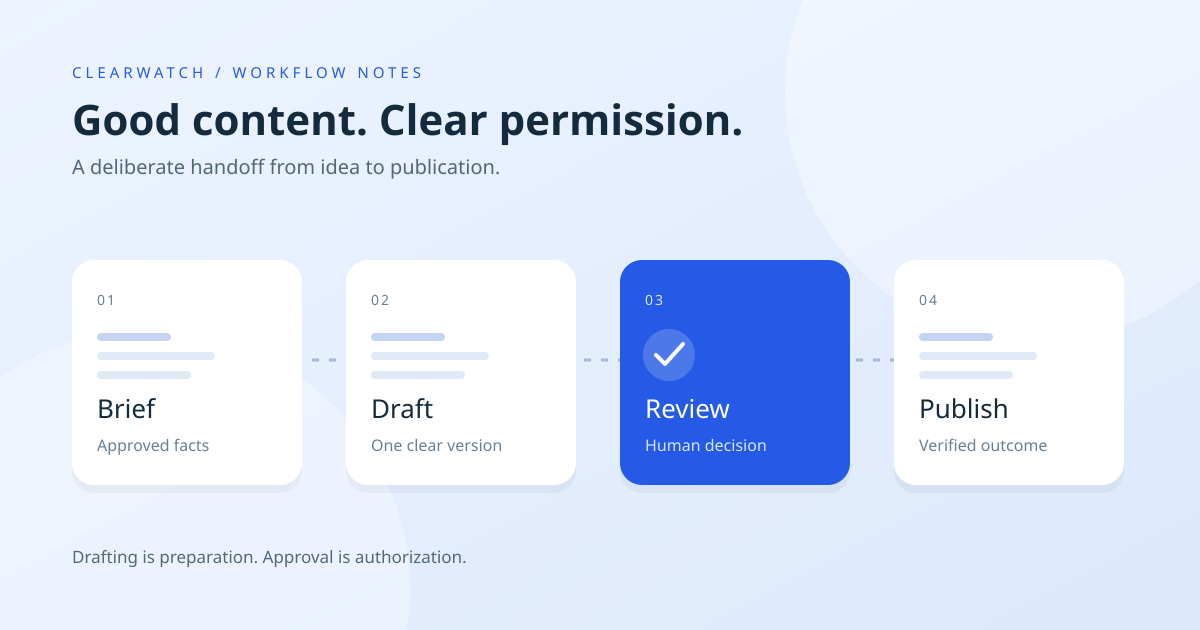
A social post usually needs more than a caption: an image, accurate offer details, the right location, a destination link, and someone who can approve it. Generating more drafts does not help if the team loses track of which version is ready.
The workflow below is a recommended starting design for a small business, not a report of customer results. It separates drafting, approval and publishing so you can automate preparation without giving a draft permission to go live.
1. Collect one useful brief instead of scattered messages
Start with a simple form or shared record. Ask for the objective, audience, store or business unit, channel, intended date, approved facts, asset links and reviewer. For a promotion, also capture the price, eligibility, start and end dates, and any required wording. Unknown information should stay visibly unknown.
Keep a small brand reference alongside the brief: preferred tone, words to avoid, approved product descriptions and examples the team actually likes. Let the person responsible for marketing define these standards. AI should help carry out that judgment, not quietly replace it.
Illustrative brief: “Introduce the quiet work area at Location A. Use the approved room photo. Do not imply that desks can be reserved. Draft one informational post for review.” This is more useful than “Make a great post about our business.”
2. Produce a review package, not just a caption
Give the drafting step only the relevant approved material. Ask for a caption, suggested image, alt text, destination URL and a short list of facts requiring verification. Put the original brief next to the draft so the reviewer can compare them without searching another app.
Do not let the model invent testimonials, performance numbers, availability or customer outcomes. NIST’s Generative AI Profile offers a broader framework for evaluating generative-AI risks. For this workflow, a practical design choice is to require a visible source for each factual claim.
Marketing claims also need scrutiny beyond whether the wording sounds plausible. The FTC’s small-business advertising guidance explains that advertisers need a reasonable basis for claims before an ad runs. A polished AI draft is not supporting evidence.
3. Make approval belong to a specific version
Assign each post a stable ID and each revision a version number. The reviewer should see the exact caption, image, link, account and planned publishing time together. An approval record should identify the reviewer, approved version and approval time.
Use explicit choices such as Approve version 3, Request changes and Reject. A chat-based approval can work if the response is attached to that exact review package and the workflow records the decision. A floating “looks good” should not approve whatever happens to be the latest draft.
If anyone changes the caption, image, offer details, target account or schedule after approval, return the post to review. For a first version, this simple rule is easier to audit than deciding which edits are “minor.”
4. Separate approved, scheduled and published
These states mean different things. Approved means a person authorized a version. Scheduled means the publishing service accepted the future job. Published means there is evidence that the post is live. Do not mark a post published just because an API request was sent.
- Draft: AI prepares the package from the brief.
- Needs review: a named person checks facts, tone, rights and targeting.
- Approved: the exact version is locked for publishing.
- Scheduled: the platform has accepted the job.
- Published or needs attention: record the live post URL, or the failure and next owner.
Before sending, recheck that approval still matches the version, the destination account is correct, required assets are available and the offer has not expired. If any check fails, stop that post and notify its owner rather than substituting new copy.
5. Give exceptions a home
Plan for a disconnected social account, missing photo, rejected upload, absent reviewer or uncertain publish result. Keep an exception queue with the post ID, reason, owner and next action. A reminder should point to something a person can resolve, not repeat a vague “automation failed” message.
For an uncertain publishing response, check the destination before retrying. Use the publishing provider’s duplicate-prevention features where available, and keep your own record of the approved version and attempted publication. The aim is to avoid turning a retry into a second public post.
A short approval checklist to reuse
- Are names, prices, dates, hours and location-specific details correct?
- Do we have permission to use the image and any quoted material?
- Does the caption match the actual image, destination link and offer?
- Are factual claims supported, rather than generated guesses?
- Does the tone match our brand, and is the alt text useful?
- Am I approving this exact version for this account and time?
Run a small pilot before expanding
Start with one channel, one reviewer and a handful of ordinary posts. Keep publishing under human approval. Track review time, revisions per post, missed approvals, publish failures and duplicate posts. Also record why reviewers change drafts: wrong facts, weak tone and missing context call for different fixes.
Review the pilot together before adding more locations or channels. If the same information is repeatedly missing, improve the brief. If posts wait too long, fix ownership or review timing. Do not assume another model or a longer prompt will solve an unclear process.
This is one part of a marketing automation workflow. If you are deciding what to automate first, use our first-workflow selection guide. For one-to-one inquiries rather than public posts, see the lead follow-up workflow.
Make your content handoff easier to run
Tell us how ideas, drafts and approvals move through your team today. Clearwatch can help map a focused workflow around your existing tools and review standards.
Discuss your workflow ↗Sources and scope
Sources checked November 13, 2026. The workflow and checklist above are Clearwatch’s practical recommendations, not a compliance certification or a claim of guaranteed results.